
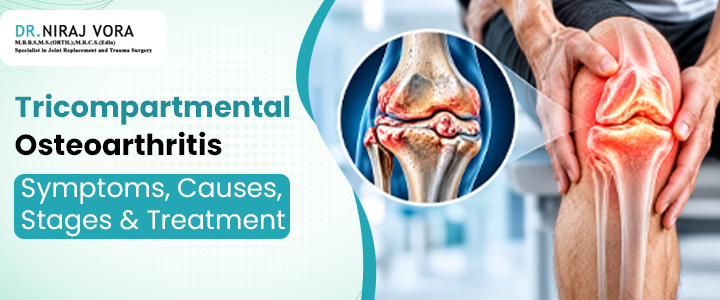
As serious as the term sounds, “Tricompartmental Osteoarthritis” is a condition that affects all three compartments of the knee. This means that the pain, stiffness, and restricted movement can involve all three parts of the joint – a triple threat. And there’s more.
Tricompartmental Osteoarthritis doesn’t follow a straightforward path:
Unlike conventional arthritis, it does not always follow a straightforward pattern:
Some patients may develop symptoms gradually, while others may notice a sudden worsening that makes the condition feel like it progressed overnight. And the extent of changes seen on an X-ray does not always match how a person may experience the condition:
Severe-looking arthritis & non-surgical treatment: A knee can show extensive damage on an X-ray and yet the first step may still be non-surgical treatment because the symptoms are mild and the person is functioning reasonably well (and yes, that can happen).
Less knee damage, more treatment: An X-ray may show less damage, and yet the person may need more intensive treatment simply because of more pain and loss of function (that can happen too)
Sometimes even a report that sounds alarming does not automatically mean “you need a knee replacement.”
Treatment for Tricompartmental Osteoarthritis, unlike regular arthritis, depends on how the knee affects everyday life and other treatment options.
So what exactly is tricompartmental osteoarthritis? What causes it, what symptoms should you watch for, and how can you know when it has become serious when it follows this non-linear approach?
We asked an Orthopedic specialist and Mumbai’s top knee replacement surgeon, Dr Niraj Vora, and here are answers straight from the specialist on tricompartmental osteoarthritis in the next 10 minutes:
What is Tricompartmental Osteoarthritis? What causes it?
The knee joint comprises three compartments: the medial (inner), lateral (outer), and patellofemoral (behind the kneecap). Conventional osteoarthritis often affects only one compartment. Osteoarthritis that affects all three knee compartments is called tricompartmental osteoarthritis.
Age is often the most common cause, as the cartilage naturally wears out over time and with use. A family history of arthritis is another common and major driver of degeneration and damage across all three compartments.
Because excess body weight contributes through increased mechanical load and low-grade systemic inflammation, obesity also contributes to tricompartmental damage, along with prior injury, allowing wear to spread across compartments rather than remain localized. Repetitive occupational or activity-related strain can produce a similar cumulative effect.
Symptoms: How do you spot tricompartmental osteoarthritis?
Pain that is distributed across the knee, stiffness, intermittent swelling, grinding and clicking sensations, and reduced range of motion are symptoms similar to any arthritis. Still, they are generally more pronounced across the joint.
The severity of the symptoms varies, and the severity is graded in stages:
In the early stage, wear is minimal, and stiffness is intermittent, often manageable through lifestyle measures alone.
In the moderate stage, cartilage loss becomes more apparent, pain and stiffness occur more regularly, and daily activities may be affected.
In the advanced stage, cartilage loss spans all three compartments, bone-on-bone contact may be present, and pain and functional limitation are typically more constant.
“However, as is often the case, radiological studies like X-rays and reported symptoms do not always correlate in cases of tricompartmental osteoarthritis. A patient graded as severe may still be managed effectively without surgery, whereas a patient graded as moderate may experience more limitations than expected. Stages are often graded to inform clinical decision-making, and don’t solely determine treatment for tricompartmental osteoarthritis,” says Osteoarthritis specialist in Mumbai, Dr. Niraj Vira. When asked about the treatment for tricompartmental osteoarthritis, here’s what he had to say.
Treatment for Tricompartmental Osteoarthritis in Mumbai:
A thorough diagnosis of osteoarthritis, driven by clinical examination and symptom severity, guides the treatment recommendations for tricompartmental osteoarthritis, which are often as follows:
First stage (non-surgical): Physiotherapy, weight management, anti-inflammatories, bracing, activity changes, and sometimes injections.
Second stage (Surgery): Arthroscopy for specific mechanical issues, partial knee replacement (occasionally, if damage is concentrated in one area), or total knee replacement for advanced cases that aren’t responding to conservative care.
When the damage spans all three compartments (which is often the case), partial replacement can’t fully resolve the issue. At that stage, total knee replacement becomes the standard procedure.
Treatment for Severe Tricompartmental Osteoarthritis: Total Knee Replacement
Total knee replacement is standard, but it is also a more demanding procedure: it resurfaces the entire joint in one go, addresses bone, ligaments, and alignment at once, and leaves less room to correct course later since it’s largely a one-shot operation.
In short, success depends on precision, and that precision is where the experience and expertise of the osteoarthritis surgeon become paramount in performing total replacement surgery. If you are in Mumbai and experiencing severe pain and mobility issues due to tricompartmental arthritis, we suggest booking a consultation with a leading osteoarthritis surgeon and tricompartmental arthritis specialist in Mumbai, Dr. Niraj Vora, for more information.